After long months of a shut-down social life, an exhibition opening is a good opportunity to be together, to see art and people, and to discuss it.
The title of the new exhibition "Zusammen" (Together) at the Creative Hub Bremen fits the venue perfectly, because not only does it house over 100 projects, rooms, studios, associations, offices and workshops, but it also offers many different people opportunities for working, networking and cooperation, as well as coaching and workshops. It is the ideal place for working, celebrating, living and thinking together.
From art history, being together is known as multi-figure representations, for example from images of animal groups from the Lasceaux caves, from biblical double portraits like Adam and Eve, or from battle paintings, and even this year's documenta fifteen has dedicated itself to "collectivity, the building of communal resources, fair distribution and cooperation".
Most of us will have experienced the magic of collaboration for ourselves, for example when a team achieves a result that would not have been possible for an individual. Beyond teams, we also come together as collections of individuals in collectives, partnerships, clubs, orchestras, football teams and other groupings. Management literature in recent years has been keen to point out the benefits of diverse teams with the widest possible range of skills. A well-known example of this can be found close to home in the fairytale of the Town Musicians of Bremen, where on the one hand people expect joint artistic success from performing as a „choir“, and where on the other hand the special abilities of each individual make a decisive contribution to victory over the robbers.
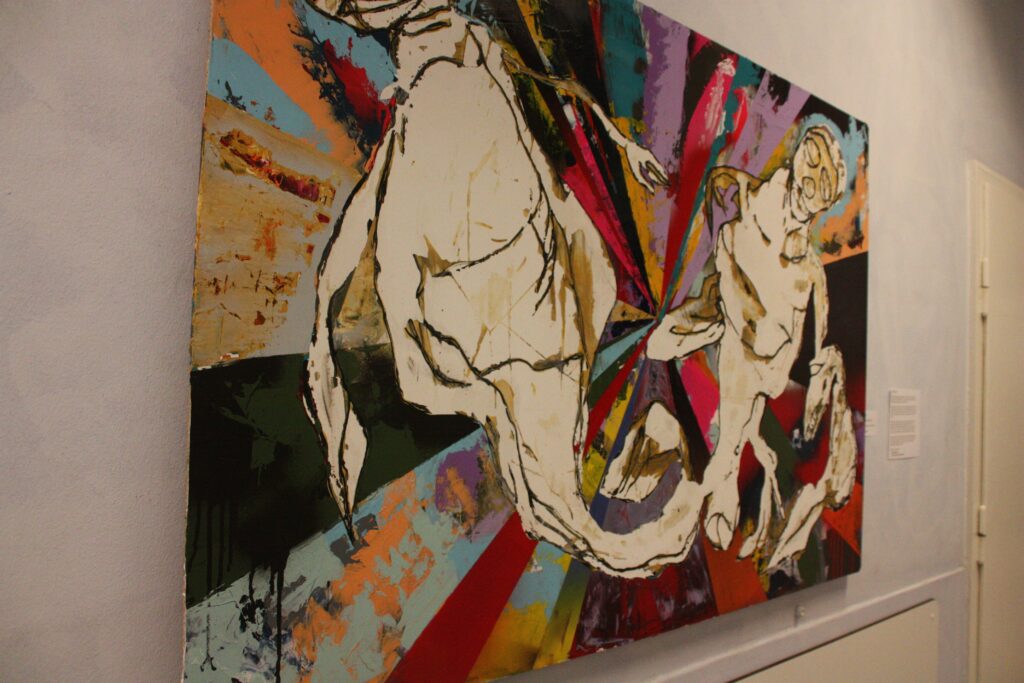
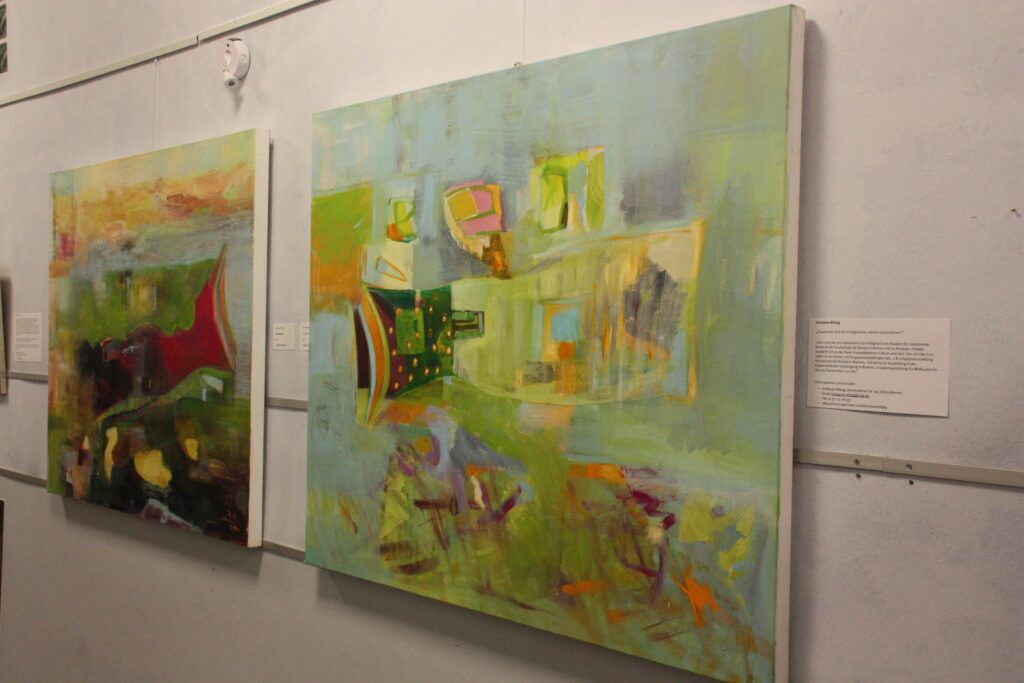
The works shown in the exhibition take up the theme of "together" on a content-related, conceptual, or material level.
This is how Birgit Heimburg introduces us to the ancient fable of the spherical humans; in Karin Bredow's work we see the people of Nigeria in tribal clothing; Judith Dannemann movingly depicts the trust between a child and an adult, and Timo Willgerod presents a young couple who stand before us life-sized and with whom we could enter into dialogue. Ully Schneider plays a joke on human communication patterns with his "communicating tubes", and Christian Peters questions being together as an antithesis. In Uwe Köhler's "Ruder 2er" we see a well-rehearsed team, and the "storytellers" by Cosima Schierenbeck confront us as a group of active figures. In Claudia Gattner's work, ice skaters move to the Vienna Waltz - just as the figures grouped in a circle by Petra von Seggern can be seen as a form of dance. Dörte Schmidt's message about humanity is "individually we are notes, together we are a song".
On a material level, Karin Pörtner surprise us with unexpected combinations of materials within the object frame, Peter Holz with a small volcano, Brigitte Ogiolda with "multi-layered" arrangements of photographs of distant lands combined with found objects from Bremen. In Kristiane Mittag's paintings, areas of colour combine to form meaningful structures whose function or effect can be linked to one's own associations, and Hildegunde Krawinkel shows us the equal coexistence of image and text as a new whole.
In the group of experimental-conceptual works, Heiko Ahrens has combined several triangular laths into an impressive physical experiment that reveals itself as you walk past. As "Zusammenwerk" (collaboration) in the literal sense, Rebekka Kalbas and Uwe Teichmann present excerpts from their joint project "1000 Parts", on which they actually work together. Heike Seyffarth shows similar, but not identical, circling thoughts in 12 heads. Werner von Buchka lets us take part in photographic experiments that can only be achieved through precise cooperation between the people in front of and behind the camera.
Exhibition guests are invited to search the presented works for further shared allusions to music, dance, image-text combinations, the surprisingly frequent motif of the zigzag line and further discoveries.
A heartfelt thank you goes to everyone who made the exhibition at this location possible: the Creative Hub team, Gewoba for the opportunity of temporary use, and all the exhibiting artists.
speaker: Heike Seyffarth, curator of the exhibition